 |
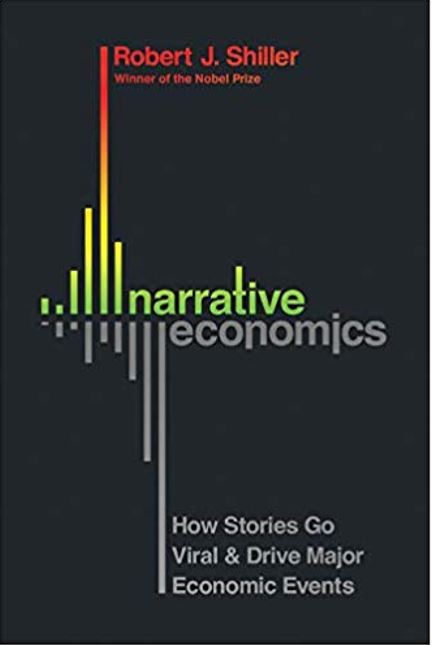
Narrative Economics: How Stories Go Viral and Drive Major Economic Events
Princeton University Press,
September 2019, 410 pp.
In a world in which internet troll farms attempt to influence foreign elections, can we afford to ignore the power of viral stories to affect economies?
In this groundbreaking book, Nobel Prize winning economist and New York Times bestselling author Robert Shiller offers a new way to think about the economy
and economic change.
Using a rich array of historical examples and data, Shiller argues that studying popular stories that affect individual and collective economic behavior, what he calls
"narrative economics" has the potential to vastly improve our ability to predict, prepare for, and lessen the damage of financial crises, recessions, depressions,
and other major economic events.
Spread through the public in the form of popular stories, ideas can go viral and move markets, whether it's the belief that tech stocks can only go up, that housing
prices never fall, or that some firms are too big to fail. Whether true or false, stories like these, transmitted by word of mouth, by the news media, and increasingly by social media, drive the economy by driving our decisions about how and where to invest, how much to spend and save, and more. But despite the obvious importance of such stories, most economists have paid little attention to them. Narrative Economics sets out to change that by laying the foundation for a way of understanding how stories help propel economic events that have had led to war, mass unemployment, and increased inequality.
The stories people tell, about economic confidence or panic, housing booms, the American dream, or Bitcoin, affect economic outcomes. Narrative Economics explains how
we can begin to take these stories seriously.
Translations:
Chinese Simplified: China CITIC Press
German: Plassen Verlag
Italian: Franco Angeli
Japanese: Toyo Keizai
Korean: R H Korea Co. Ltd.
Portuguese: Intrinseca
Spanish: (Gestion 2000)
|
|

Sovereign GDP-Linked Bonds: Rationale and Design
Centre for Economic Policy Research,
March 16, 2018.
with James Benford and Jonathan D. Ostry
Indexing government debt repayments to its GDP has for a long time been seen as a possible way of recession-proofing government balance sheets by shifting the burden of adjustment in downturns from taxpayers to investors with deep pockets. When growth is weak, the government's debt servicing costs would decline and its debt-to-GDP ratio would stabilise rather than rise, reducing the need for an immediate fiscal consolidation. When growth is strong, and the government's revenues are high, the return on the GDP-linked bond would increase in line with repayment capacity.
Intermittent groundswells in policy and academic support for GDP-linked bonds over the past half century (Shiller 1993, Obstfeld and Peri 1998, Haldane 1999, Council of Economic Advisors 2004, Borensztein and Mauro 2004, Blanchard et al. 2016) have resulted in some incremental progress towards issuance. GDP-linked warrants, which contain an element of indexation to GDP providing holders with a higher coupon if GDP exceeds some threshold level have been issued by a small number of countries as part of debt restructuring agreements (Costa Rica, Bulgaria, and Bosnia and Herzegovina in the 1980s and 1990s; and since then, Argentina, Greece, and Ukraine). In 2014, Uruguay issued a $1 billion bond with principal and coupon payments indexed to nominal wages. Portugal recently issued small-denomination bonds to domestic savers with additional payouts tied to GDP.
However, no sovereign has yet issued a marketable GDP-linked bond where institutional investors take on both the upside and the downside risk of GDP movements, with returns varying symmetrically, falling with lower GDP and rising with higher GDP.
Drawing among other things on work commissioned by the recent Chinese and German presidencies of the G20, a new VoxEU eBook edited by James Benford, Jonathan D. Ostry and Robert Shiller, and with a foreword by Andy Haldane and Maurice Obstfeld explores what has been holding back innovation, weighs up the pros and cons from both the issuer's and investor's perspective, and looks at what an intelligently designed GDP-linked bond that overcomes the perceived impediments to issuance might look like (Benford et al. 2018).
 |
Phishing for Phools: The Economics of Manipulation and Deception
Princeton University Press,
September 2015, 280 pp.
with George Akerlof
"Phishing" is a popular new word taken from computer culture which refers to being cheated online.
We use it in a broader sense to encompass all kinds of economic manipulation. A 'phool" is anyone
(including, at times, us, the authors), whose psychological or emotional weakness and lack of information
make them susceptible to being phished. We argue that this phishing is more universal than most appreciate.
Our book’s cover has a cartoon by Ed Koren that illustrates what we mean. An unconstrained free market economy can
be thought of as a lake with a million different kinds of fishing lures designed by skilled professionals,
all dangled before us: no matter how hard we try we are sure to make a mistake and bite on some.
A key concept put forth in this book is that of phishing equilibrium. If all other businesses are phishing, your business
has to phish too, if it will survive the competition. The phishing that we observe is usually better thought of
not as the willful actions of some evil people but as a natural consequence of an unregulated economic system that
puts businesses into highly competitive environments and often razor-thin profit margins. When ethical business
standards are not binding they will be forced to use all their ingenuity to find more and more powerful ways to phish,
and the winners in the phishing competition may eventually see their businesses amplified exponentially.
We wrote this book as admirers of the free market system but hoping to help people better find their way in it.
The economic system is filled with trickery, and everyone has needs to know that. We all have to navigate this system,
in order to maintain our dignity and integrity, and we all have to find inspiration to go on despite craziness all
around us.
Translations:
Chinese Complex: Commonwealth Publishing Taiwan
Chinese Simplified: China CITIC Press
Croatian: Znanje
Czech: Albatross Media a. s.
Dutch: Amsterdam University Press
French: Editions Odile Jacob
German: Econ imprint of Ullstein Buchverlag
Hebrew: Yedioth Books
Hungarian HVG Konyvek
Italian: Edizioni Mondadori
Japanese: Toyo Keizai
Korean: Random House Korea
Lithuanian: Svieskime Vaikus Charity Foundation
Polish: Polskie Towarzystwo Ekonomiczne
Portuguese: Livraria Almedina (Portugal)
Portuguese: Editora Alta (Brazil)
Romanian: Publica.com
Russian: Mann-Ivanov-Ferber Publishers
Spanish: Deusto (Gestion 2000)
Turkish: Kapital Yayinevi
Ukrainian: Nash Format
Vietnamese: Nha Nam publishing and Communication JSC
|
|
|
|
|
|



Irrational Exuberance
Princeton University Press, March 2000 (paperback Broadway Books, April 2001)
2nd Edition: Princeton University Press, 2005 (paperback Currency/Doublday 2006)
3rd Edition: Princeton University Press, 2015
This first edition of this book was a broad study, drawing on a wide range of published
research and historical evidence, of the enormous stock market boom that started around
1982 and picked up incredible speed after 1995. Although it took as its specific starting
point this ongoing boom, it placed it in the context of stock market booms generally, and
it also made concrete suggestions regarding policy changes that should be initiated in
response to this and other such booms. The book argued that the boom represents a
speculative bubble, not grounded in sensible economic fundamentals. Part one of the
book considered structural factors behind the boom. A list of twelve precipitating factors
that appear to be its ultimate causes was given. Amplification mechanisms,
naturally-occurring Ponzi processes, that enlarge the effects of these precipitating
factors, were described. Part Two discussed cultural factors, the effects of the news
media, and of "new era" economic thinking. Part Three discussed psychological
factors, psychological anchors for the market and herd behavior. Part Four discussed
attempts to rationalize exuberance: efficient markets theory and theories that investors
are learning. Part Five presented policy options and actions that should be taken.
Hardcover 296 pages, paperback 304 pages.
The second edition, 2005, added an analysis of the real estate bubble as similar to the
stock market bubble that preceded it, and warned that "Significant further rises in
these markets could lead, eventually, to even more significant declines. The bad outcome
could be that eventual declines would result in a substantial increase in the rate of
personal bankruptcies, which could lead to a secondary string of bankruptcies of financial
institutions as well. Another long-run consequence could be a decline in consumer and
business confidence, and another, possibly worldwide, recession." Thus, the second
edition of this book was among the first to warn of the global financial crisis that began
with the subprime mortgage debacle in 2007.
The third edition, 2015, updated for the world financial crisis 2007-9 and the "new normal" equilibrium
that followed the crisis, added a chapter on the bond market, so that the book now covers all three major
asset classes, stocks, bonds and real estate.
Contents, Preface and Sample Chapter
and Online Data.
Stock market data used in this book: Excel file (.xls),
Housing market data used in this book: Excel file (.xls).
Other Editions:
Scribe Publications paperback 2000 (Australia and New Zealand)
Princeton University Press paperback 2001 (UK only)
Audible.com, audio edition 2000
New Age International (P) Limited Publishers, for India, Bangladesh, Bhutan, Myanmar, Sri
Lanka, Nepal and Pakistan
Translations:
Arabic: Obeikan Publishers, Saudi Arabia
Chinese (simplified characters): Chinese People's University Press, China/Liang
Jing Publishing Studio
Chinese (complex characters): China Times Publishers, Taiwan
Czech: Grada Publishing French: Valor editions, France
German: Campus Verlag, Germany
Greek: Livanis Publications, Greece
Hungarian: Alinea, Hungary
Italian: Il Mulino, Italy
Korean: Maeil Business Newspapers, Korea, RHK RH Korea
Japanese: Diamond, Japan
Macedonian: Securities and Exchange Commission, Macedonia
Portuguese: Makron, Brazil
Russian: Alpina Non-Fiction
Spanish (Mexico): Turner Publications/Oceana
Spanish (Spain): Expansion, Kiosk Edition
Thai: The Capital Publishing Company
Turkish: Rota Publishers, Turkey
 |
Finance and the Good Society
Princeton University Press,
April 2012, 280 pp.
The reputation of the financial industry could hardly be worse than it is today in the
painful aftermath of the 2008 financial crisis. New York Times best-selling economist
Robert Shiller is no apologist for the sins of finance — he is probably the only
person to have predicted both the stock market bubble of 2000 and the real estate bubble
that led up to the subprime mortgage meltdown. But in this important and timely book,
Shiller argues that, rather than condemning finance, we need to reclaim it for the common
good. He makes a powerful case for recognizing that finance, far from being a parasite on
society, is one of the most powerful tools we have for solving our common problems and
increasing the general well-being. We need more financial innovation — not less
— and finance should play a larger role in helping society achieve its goals.
Challenging the public and its leaders to rethink finance and its role in society, Shiller
argues that finance should be defined not merely as the manipulation of money or the
management of risk but as the stewardship of society's assets. He explains how people in
financial careers — from CEO, investment manager, and banker to insurer, lawyer, and
regulator — can and do manage, protect, and increase these assets. He describes how
finance has historically contributed to the good of society through inventions such as
insurance, mortgages, savings accounts, and pensions, and argues that we need to envision
new ways to rechannel financial creativity to benefit society as a whole. Ultimately,
Shiller shows how society can once again harness the power of finance for the greater
good.
Translations:
Chinese: CITIC
Chinese Complex: Commonwealth Publishing Group
Croatian: Mate Publishers
German: Campus Verlag
Italian: Il Mulino
Japanese: Toyo Keizai
Korean: Random House Korea
Portuguese: Editora Campus
Spanish: Gestion 2000 (Planeta)
 |
Reforming US Financial Markets: Reflections Before and Beyond Dodd-Frank
MIT
Press, 2011, 152 pp.
with Randall Kroszner
Over the last few years, the financial sector has experienced its worst crisis
since the 1930s. The collapse of major firms, the decline in asset values, the
interruption of credit flows, the loss of confidence in firms and credit market
instruments, the intervention by governments and central banks: all were extraordinary in
scale and scope. In this book, leading economists Randall Kroszner and Robert Shiller
discuss what the United States should do to prevent another such financial meltdown. Their
discussion goes beyond the nuts and bolts of legislative and regulatory fixes to consider
fundamental changes in our financial arrangements. Kroszner and Shiller offer two
distinctive approaches to financial reform, with Kroszner providing a systematic analysis
of regulatory gaps and Shiller addressing the broader concerns of democratizing and
humanizing finance. Kroszner focuses on key areas for reform, including credit rating
agencies and the mortgage securitization market. Shiller argues that reform must serve to
make the full power of financial theory work for everyone — bringing the technology
of finance to bear on managing risk, for example — and should acknowledge the reality
of human nature. After brief discussions by four commentators, Kroszner and Shiller each
offer a response to the other’s proposals, creating a fruitful dialogue between two
major figures in the field.
 |
The Squam Lake Report: Fixing the Financial Markets
Princeton University Press,
June 2010, 168 pp.
with Kenneth R. French, Martin N. Baily, John Y. Campbell, John H. Cochrane,
Douglas W. Diamond, Darell Duffie, Anil Kashyap, Frederic Mishkin, Raghuram Rajan, David
S. Scharfstein, Hyun Song Shin, Matthew J. Slaughter, Jeremy C. Stein, and Rene M. Stulz
In the fall of 2008, fifteen of the world's leading economists--representing the
broadest spectrum of economic opinion--gathered at New Hampshire's Squam Lake. Their goal:
the mapping of a long-term plan for financial regulation reform. The Squam Lake Report
distills the wealth of insights from the ongoing collaboration that began at these
meetings and provides a revelatory, unified, and coherent voice for fixing our troubled
and damaged financial markets.
 |
Animal Spirits: How Human Psychology Drives the Economy
And Why It Matters for Global Capitalism
Princeton University Press,
March 2009, 264 pp.
with George Akerlof
The global financial crisis has made it painfully clear that powerful psychological forces
are imperiling the wealth of nations today. From blind faith in ever-rising housing prices
to plummeting confidence in capital markets, "animal spirits" are driving
financial events worldwide. In this book, acclaimed economists George Akerlof and Robert
Shiller challenge the economic wisdom that got us into this mess, and put forward a bold
new vision that will transform economics and restore prosperity.
Akerlof and Shiller reassert the necessity of an active government role in economic
policymaking by recovering the idea of animal spirits, a term John Maynard Keynes used to
describe the gloom and despondence that led to the Great Depression and the changing
psychology that accompanied recovery. Like Keynes, Akerlof and Shiller know that managing
these animal spirits requires the steady hand of government — simply allowing markets
to work won't do it. In rebuilding the case for a more robust, behaviorally informed
Keynesianism, they detail the most pervasive effects of animal spirits in contemporary
economic life — such as confidence, fear, bad faith, corruption, a concern for
fairness, and the stories we tell ourselves about our economic fortunes — and show
how Reaganomics, Thatcherism, and the rational expectations revolution failed to account
for them.
Other Editions:
Kindle (Amazon.com electronic book)
Audible.com (Brilliance Audio)
Translations:
Chinese (simplified): CITIC
Chinese (complex): Commonwealth Publishing
Czech: Dokoran
Dutch: Business Contact
Finnish: Helsinki University Press
French: Pearson France, Champsessais
German: Campus Verlag
Greek: Epikentro Publishers
Hungarian: Corvina Publisher
Italian: Rizzoli
Japanese: Toyo Kezai
Korean: Random House Korea, Inc
Macedonian and Albanian: Ars Lamina
Polish: Studio Emka
Portuguese (Brazil): Agencia RIFF
Portuguese (Portugal): Grupo Editorial Campus
Romanian: Publica
Russian: United Press (Alpina imprint)
Serbian: Sluzhbeni Glasnik
Spanish: Gestion 2000, Spain
Thai: Matichon Publishing House
Turkish: Scala Yayincilik
Vietnamese: Alpha Books
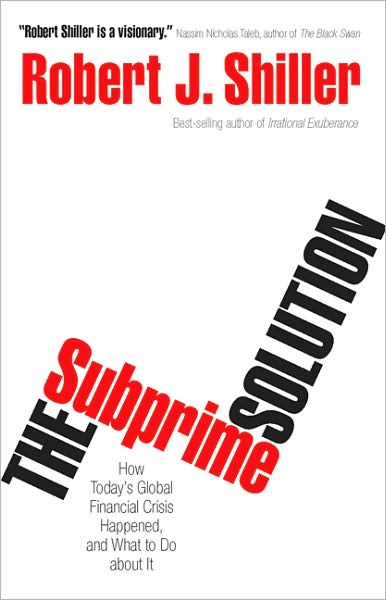 |
Subprime Solution: How Today’s Global Financial Crisis
Happened and What to Do about It
Princeton University Press,
September 2008, 208 pp.
The subprime mortgage crisis has already wreaked havoc on the lives of millions of people
and now it threatens to derail the U.S. economy and economies around the world. In this
trenchant book, best-selling economist Robert Shiller reveals the origins of this crisis
and puts forward bold measures to solve it. He calls for an aggressive response — a
restructuring of the institutional foundations of the financial system that will not only
allow people once again to buy and sell homes with confidence, but will create the
conditions for greater prosperity in America and throughout the deeply interconnected
world economy.
Shiller blames the subprime crisis on the irrational exuberance that drove the economy's
two most recent bubbles — in stocks in the 1990s and in housing between 2000 and
2007. He shows how these bubbles led to the dangerous overextension of credit now
resulting in foreclosures, bankruptcies, and write-offs, as well as a global credit
crunch. To restore confidence in the markets, Shiller argues, bailouts are needed in the
short run. But he insists that these bailouts must be targeted at low-income victims of
subprime deals. In the longer term, the subprime solution will require leaders to revamp
the financial framework by deploying an ambitious package of initiatives to inhibit the
formation of bubbles and limit risks, including better financial information; simplified
legal contracts and regulations; expanded markets for managing risks; home equity
insurance policies; income-linked home loans; and new measures to protect consumers
against hidden inflationary effects.
Other Editions:
Kindle (Amazon.com electronic book)
I-tunes (Audio edition)
Translations:
Chinese CITIC
German: Boersenmedien AG
Italian: EGEA S.p.A. Milano
Japanese: Nippon Hyoronsha Co,, Ltd
Korean: Random House Korea, Inc
Portuguese: Ana Paula Faria Editora, Portugal
Spanish Gestion 2000 (Grupo Planeta), Spain
 |
The New Financial Order: Risk in the 21st Century
Princeton University Press, April 2003, 400 pp.
In his best-selling Irrational Exuberance, Robert Shiller cautioned that society's
obsession with the stock market was fueling the volatility that has since made a roller
coaster of the financial system. Less noted was Shiller's admonition that our infatuation
with the stock market distracts us from more durable economic prospects. These lie in the
hidden potential of real assets, such as income from our livelihoods and homes. But these
''ordinary riches,'' so fundamental to our well-being, are increasingly exposed to the
pervasive risks of a rapidly changing global economy. This compelling and important new
book presents a fresh vision for hedging risk and securing our economic future.
Shiller describes six fundamental ideas for using modern information technology and
advanced financial theory to temper basic risks that have been ignored by risk management
institutions — risks to the value of our jobs and our homes, to the vitality of our
communities, and to the very stability of national economies. Informed by a comprehensive
risk information database, this new financial order would include global markets for
trading risks and exploiting myriad new financial opportunities, from inequality insurance
to intergenerational social security. Just as developments in insuring risks to life,
health, and catastrophe have given us a quality of life unimaginable a century ago, so
Shiller's plan for securing crucial assets promises to substantially enrich our condition.
Once again providing an enormous service, Shiller gives us a powerful means to convert our
ordinary riches into a level of economic security, equity, and growth never before seen.
And once again, what Robert Shiller says should be read and heeded by anyone with a stake
in the economy.
Translations:
Chinese simplified characters: Chinese People's University Press/Liang Jing Publishing
Studio, China, China CITIC Press
Chinese complex characters: China Times Publishing Company, Taiwan
French: de boeck
German: Campus Verlag, Germany
Italian: Il Sole 24 Ore, Italy
Japanese: Nikkei, Japan
Korean: Min Media, Korea
Spanish: Turner Publications Spain/Oceana Mexico
|
|

Macro Markets: Creating Institutions for Managing Society's Largest Economic
Risks
Oxford
University Press, 1993
It is proposed that a new class of markets, macro markets, markets for claims on aggregate
income and service flows, be established. These markets would help people to manage the
biggest economic risks facing society. Our existing financial markets are inadequate to
deal with such risks. Our stock markets are markets for claims on corporate dividends, and
yet the latter are only a few percent of national incomes, only 3 percent in the United
States. The proposal here is to establish liquid international markets for claims on the
other 97 percent. These would include markets for national incomes, components and
aggregates of national incomes, and real estate. Establishing such unprecedented new
markets presents some technical problesm which this book attempts to solve. There are
proposals for perpetual futures market design, and for new index number construction
methods for cash settlement of contracts. [254 pages]
Contents: 1. Introduction, 2. Psychological Barriers, 3. Mechanisms for Hedging
Long Streams of Income, 4. National Income and Labor Income Markets, 5. Real Estate and
Other Markets, 6. The Construction of Index Numbers for Contract Settlement, 7. Index
Numbers: Issues and Alternatives, 8. The Problem of Index Revisions, 9. Making It Happen,
Notes, References, Index
Available on Oxford
Scholarship Online
Translations:
Chinese Simplified Characters: Academic Works in Economics Series, Oxford University
Press, United Kingdom
|
|
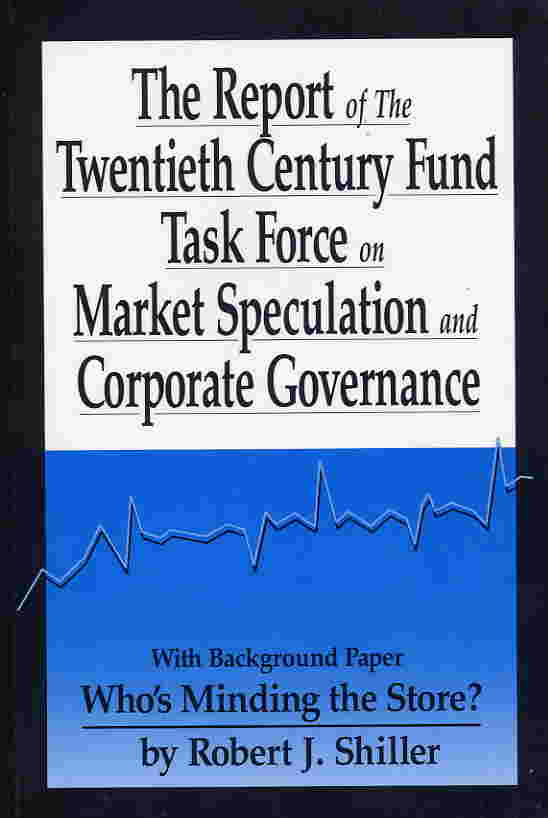
Who's Minding the Store?
The Century Foundation,
1992
Managers of firms whose shares are traded find themselves operating under wrong incentives
(making decisions in light of anticipated effects on the market rather than the true value
of their company) and securities' values are often removed from their true value, causing
costly and unnecessary disruptions in the economy. But it appears to be impossible to tax
or otherwise discourage harmful speculative behavior directly. Policy measures to reduce
excessive speculative behavior might include encouraging long-term relationship investing
by institutions, bonus incentive systems for managers tied to longer term returns on
stock, and occasional efforts by the Federal Reserve to stabilize the stock market through
monetary policy or margin requirements. [142 pages]
Contents: [Foreword by Richard C. Leone, Report of the Task Force, Dissent by James Tobin, Comment by Horace DePodwin], Who's Minding the Store: 1. Speculation and Market Volatility, 2. Recent Concerns and Policy Proposals, 3. Speculation and Economic Theory, 4. Today's Concerns with Speculative Behavior, 5. Measures for Dealing with Speculation and Short-Termism, 6. Discount Rates and Saving Rates, 7. Conclusion: Sorting Through an Array of Policy Options Notes, References, Index
 |
Market Volatility
(ISBN 0-262-69151-5, $22.00), MIT
Press, Cambridge MA, 1989.
The origins of price movements are poorly known in all speculative markets: markets for
corporate stocks, bonds, homes, land, commercial structures, commodities, collectables,
and foreign exchange. Why do stock prices often change up or down 20% in a year's time?
Why do long term bond prices sometimes change up or down as much? Why do we sometimes find
"hot" markets for homes, with prices sometimes jumping or more 20% in a year,
after years of stable prices? The book presents basic research on the ultimate causes of
price volatility in speculative markets, on the causes that make good economic sense and
on the causes that are psychological or sociological in origin. The research, conducted
over the last dozen years, includes both my own work and joint research with John Y.
Campbell, Karl E. Case, Sanford J. Grossman, and Jeremy J. Siegel. About two thirds of the
book consists of previously published articles. [464 pages] Chapter
26 and Online Data
Contents: Introduction, 1. Stock Prices and Social Dynamics, 2. Fashions,
Fads and Bubbles in Financial Markets, 3.The Stock Market: Overview, 4. Stock Market
Volatility, An Introductory Survey, 5. Do Stock Prices Move Too Much to be Justified by
Subsequent Changes in Dividends, 6. The Use of Volatility Measures in Assessing Market
Efficiency, 7. The Probability of Gross Violations of a Present Value Variance Inequality,
8. Stock Prices, Earnings, and Expected Dividends, 9. The Dividend-Ratio Model and
Expected Dividends, 10. Comovements in Stock Prices and Comovements in Dividends, 11.
Factors and Fundamentals, 12. The Bond Market: Overview, 13. Bond Market Volatility: An
Introductory Suvery, 14. The Gibson Paradox and Historical Movements in Long-Term Interest
Rates, 15. The Volatility of Long-Term Interest Rates and Expectations Models of the Term
Structure, 16. Cointegration and Tests of Present Value Models, 17. The Real Estate
Market: Overview, 18. The Efficiency of the Market for Single Family Homes, 19. The
Aggregate Economy, Overview, 20. Ultimate Sources of Aggregate Variability, 21 The
Determinants of the Variability of Stock Market Prices, 22. Popular Models and Investor
Behavior, Overview, 23. Investor Behavior in the October 1987 Stock Market Crash: Survey
Evidence, 24. The Behavior of Home Buyers in Boom and Post-Boom Markets, 25. Concluding
Notes, 26, Data Series, Author Index, Subject Index
Translations:
Chinese: Chinese People's University Press, China
| ONLINE DATA | ONLINE PAPERS | BOOKS | PUBLICATION LIST | COURSES | SHORT BIO |